
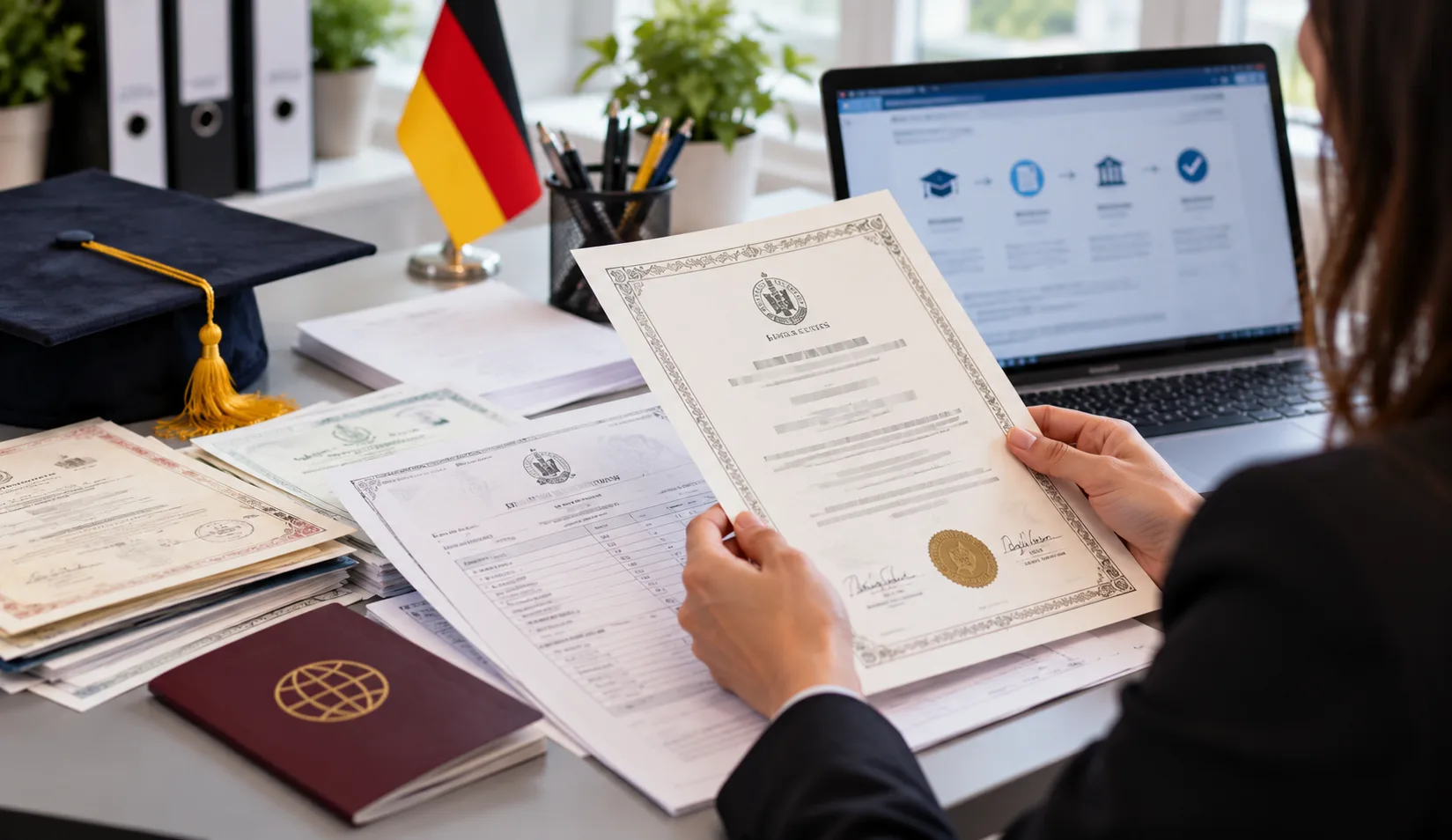
Anerkennung in Germany: how recognition works and which documents need a certified translation
/ Useful informations
If you trained or studied abroad and want to work in Germany, you will meet the word Anerkennung. It means recognition: an official check of whether your foreign qualification is comparable to a German one. Most people first learn about it from an employer, an immigration office or a counselling centre, and then discover that the application comes with a list of documents, many of which must be translated into German.
This guide explains the procedure in plain English and, above all, where translations fit in, so that you do not pay for translations twice. We are a translation office, not a recognition authority. For your translations you can request a free quote.
What Anerkennung means
In Germany, professional recognition (berufliche Anerkennung) is an equivalence check. A competent authority compares your foreign qualification with the German reference occupation and decides whether they are equivalent or whether there are substantial differences. It is a legal procedure with a written decision at the end.
Three things people often confuse
- Professional recognition (Anerkennung). The legal procedure described above. It is required for regulated professions, such as doctors, nurses, teachers and several others. For many non-regulated professions it is not required, although it can help.
- ZAB statement of comparability (Zeugnisbewertung). For university degrees, the ZAB (Central Office for Foreign Education) can issue an official assessment of how your degree compares with a German one. It is mainly useful for people with academic training in non-regulated professions. According to the official portal, neither this assessment nor an entry in the ZAB database anabin replaces professional recognition where recognition is required.
- Translation of your degree. This is only a service step. A translation does not give your degree any new legal status. It lets the competent office read it.
If you are unsure which of these applies to you, start with the official portal Anerkennung in Deutschland, which helps you find the competent authority and offers free counselling.
The procedure in six steps
- Check whether you need recognition. It depends on your profession and on your plans (employment, residence permit, further study).
- Find the competent authority. It depends on the profession and often on the federal state. The Recognition Finder on the official portal points you to it.
- Read the authority’s document list. It tells you which documents are needed, in which form, and which must be translated.
- Collect your documents. Usually originals or certified copies.
- Order the translations. After the previous steps, not before.
- Submit the application. The authority checks the file, may ask for more documents, and then decides. The result can be full recognition, partial recognition, or a requirement for further training or an exam. Authorities publish their own timeframes and fees, which differ.
Which documents usually need translation
Authorities differ, but these are typical:
- degree certificate or diploma, and transcripts of records;
- vocational training certificates;
- proof of professional experience, such as employment references;
- licences or registrations, where they exist;
- a certificate of good standing or police clearance, for some professions;
- proof of a name change, for example a marriage certificate, if your name differs between documents.
Course descriptions or syllabi are sometimes requested as well. They can be long, so ask the authority first whether it needs them.
What the authorities say about translations
Published guidance from several German recognition authorities points in the same direction:
- translations are normally expected from a translator authorised or sworn in Germany;
- translations made abroad are accepted only in exceptions, if at all, and sometimes only with extra confirmation;
- self-made translations are generally not accepted, even by qualified translators;
- the recognising authority decides what it accepts, and the guidance advises applicants to ask when in doubt.
Some authorities also want the translation attached to a certified copy of the original document. Ask your authority and tell us when ordering.
Mistakes that lead to translations being repeated
- Translating before reading the authority’s list.
- Sending scans with missing pages, cut edges or an unread back side.
- Names spelled differently across documents. See our guide on names that do not match.
- Translating documents the authority did not ask for.
- Using a translation made abroad without checking that the authority accepts it.
How we can help
We translate the documents you need. We do not decide for you which ones you need, and we do not file the recognition application. For the translation of degree certificates and transcripts see our guide on degree certificates and transcripts. If a document needs an apostille or another legalisation, see legalisations and apostilles.
- Send your authority’s document list and scans of the documents by email, WhatsApp or our online form.
- Receive a clear quote. See our prices page.
- Get your certified translations by email, and by post if the authority wants the stamped paper original.
How long your case takes depends on the number of pages and on what the authority requires, so write to us and we will tell you exactly in your case.
Frequently asked questions
Do I need Anerkennung to work in Germany?
It depends on your profession. For regulated professions, such as medicine, nursing or teaching, recognition is required. For many other professions it is not, although it can help with employers and immigration offices.
Does a ZAB evaluation or an anabin entry replace Anerkennung?
No, not where professional recognition is required. They show how your degree compares with a German one, but they do not replace the recognition procedure.
Can I use a translation made in my home country?
Only if your authority accepts it. Authorities usually expect a translation by a translator authorised in Germany, so ask before you order.
Do I have to translate all my documents?
Only those on your authority’s list. Ask for the list first and send us only what is required, which keeps your costs lower.
Will my authority accept your translation?
A certified translation by a translator authorised in Germany is what authorities usually expect, but each authority decides for itself. Tell us which office asked for it and send us its request if you have it.
Can I get a PDF before the paper original?
Many authorities want the paper original with stamp and signature. On request, we can also provide a PDF copy of the translation.
Do I pay in advance, and can I get an invoice?
Payment is made in advance after you accept the quote. You can receive the invoice online or by post, together with the translated documents, as you prefer.
Start your translation
Send us your authority’s document list and your scans, and tell us which office asked for them. We will reply with a clear quote and the next steps.
Request a free quote or contact us now, also on WhatsApp.
 Write us a review