
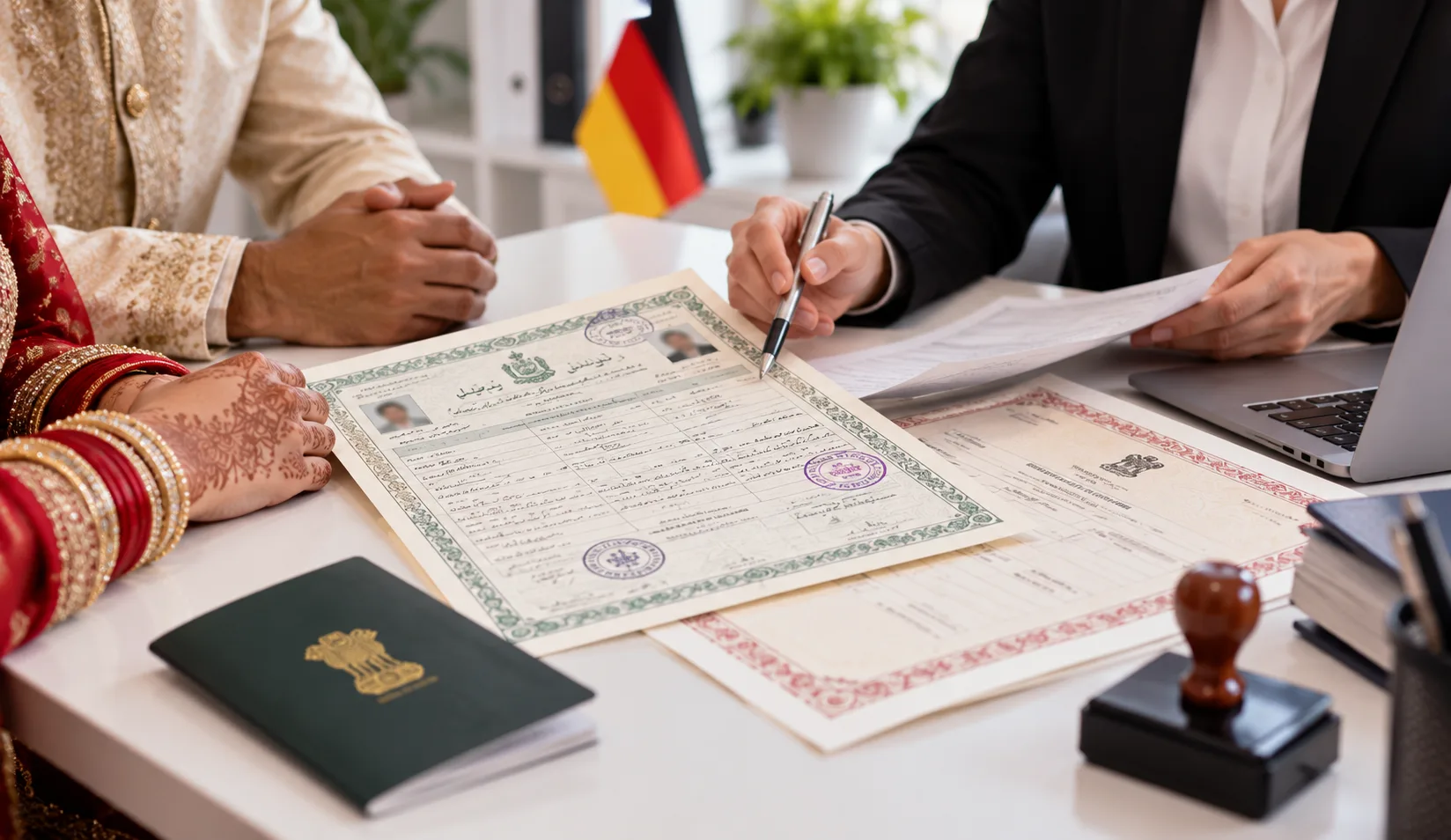
Marriage certificate and Nikah Nama: certified translation for use in Germany
/ Useful informations
German offices ask for proof of marriage more often than many people expect: for a residence permit, family reunification, a change of name, joint tax status or a citizenship application. If your marriage took place in India, Pakistan or another country, the office will usually want a certified German translation of the marriage document.
This guide explains which documents are normally translated, what the translation must contain, and how to avoid common mistakes. When you are ready, you can request a free quote for an English-German certified translation.
Which marriage documents do German offices ask for?
It depends on how and where you married, and on what the office needs.
- India: the marriage certificate issued by the registrar of marriages, for example under the Hindu Marriage Act or the Special Marriage Act. A certificate from a temple or a religious body is a different kind of document, and an office may ask for the registrar’s certificate in addition.
- Pakistan: the Nikah Nama (also written Nikahnama), the Islamic marriage contract, and the marriage registration certificate issued through the union council or NADRA.
- Other countries: the official marriage certificate issued by the civil registry.
If you are not sure which of your documents the office needs, ask them for the exact name of the document. Sending the wrong one is a common reason for repeated requests.
Why the Nikah Nama needs special care
The Nikah Nama is a long, form-based document with many columns: personal details of both spouses, witnesses, the person who conducted the ceremony, special conditions and the agreed marriage settlement (Haq Mehr). In a certified translation every filled-in column is translated, and empty or struck-out entries are described as such. Handwritten entries, stamps and signatures are also reproduced in the translation.
Please send a complete scan of all pages, front and back, including any attached pages or registration pages. Missing pages mean an incomplete translation, and German offices usually return those.
Documents in English still need a German translation
Even when the certificate is in English, German authorities generally expect a translation into German made by a translator authorised in Germany. The translator confirms the translation is complete and correct and adds signature and stamp. Offices and federal states handle details differently, so check the requirements of the office that asked for your document. One exception: for visa applications at German embassies abroad, embassy notices generally accept English-language documents without a translation. Offices in Germany usually still ask for a German translation, so check the requirements of each procedure.
Names, dates and marital status: check before you send
- Names must be consistent with your passport as far as possible. Different spellings between documents can delay your case. We transcribe each document as written, and can add a translator’s note when a name differs from another document you give us. See our guide on names that do not match.
- Dates may be written in different formats. Our translators use the German format and keep the original wording.
- Previous marital status (for example “divorced” or “widow”) is translated as written. The office may then ask for supporting documents such as a divorce decree or death certificate. We can translate those as well.
Apostille, attestation or embassy check: what applies to you?
For documents from India and Pakistan, German offices do not always follow the standard legalisation route. A registry office may instead ask the German embassy to check a document. Whether this applies to your case is decided by the office, not by the translator. If an office tells you that you need an apostille or another form of legalisation, read our page on legalisations and apostilles, or write to us first so you do not pay for a step you may not need.
Will the Bürgerbüro or registry office accept it?
A certified translation made by a translator authorised in Germany is what German offices usually expect for “registration purposes”, whether the office is a Bürgerbüro, a Standesamt or a foreigners’ office. We cannot decide for the office or guarantee acceptance, because each office has its own checklist. Tell us the name of the office and what it asked for, and send its request if you have it in writing. We will check that our translation fits it.
How it works with us
- Send your document by email, WhatsApp or our online form, and tell us which office asked for it.
- Receive a clear quote after we check the pages. You can also see our prices page.
- Get your certified translation by email, and by post if the office wants the stamped paper original.
Everything can be handled online. How long your case takes depends on the document and the requirements of the office, so write to us and we will tell you exactly how long it takes in your case.
Frequently asked questions
Do I need to translate the Nikah Nama and the marriage registration certificate?
Often both are requested, but it depends on the office. Ask which documents they need. We can translate either or both.
Is a certificate in English enough for a German office?
In most cases a German translation by an authorised translator is required, even if the certificate is in English. For a visa application at a German embassy abroad, English documents are generally accepted without a translation.
Will you translate stamps and handwritten notes?
Yes. A certified translation reproduces stamps, seals, signatures and handwritten entries, usually in brackets.
My marriage document is in Urdu or Hindi. Can you translate it?
Yes, we can translate documents in Urdu and Hindi. Send us a scan of all pages and we will give you a clear quote.
Can you help if my spouse’s name is spelled differently in other documents?
We transcribe each document as written. We add a translator’s note only when it can be justified, for example when the name differs from the same person’s name in another document you give us. The authority decides what else is needed, and we can guide you.
Will my Bürgerbüro or registry office accept your translation?
A certified translation by a translator authorised in Germany is what offices usually expect, but each office decides for itself. Tell us which office asked for it and send us its request if you have it.
Can I get a PDF before the paper original?
Many offices want the paper original with stamp and signature. On request, we can also provide a PDF copy of the translation.
Do I pay in advance, and can I get an invoice?
Payment is made in advance after you accept the quote. You can receive the invoice online or by post, together with the translated documents, as you prefer.
My certificate has text on the back. Is it translated?
Yes, if the back contains entries, stamps or notes. Send us both sides of every page.
I need it urgently. Can I get it today?
Write to us with your deadline and tell us which office asked for it. We will tell you exactly what is possible in your case.
Ready to start?
Send us your marriage document and tell us which German office asked for it. We will reply with a clear quote and the next steps.
Request a free quote or contact us now, also on WhatsApp.
 Write us a review