
Names that do not match across your documents
/ Useful informations
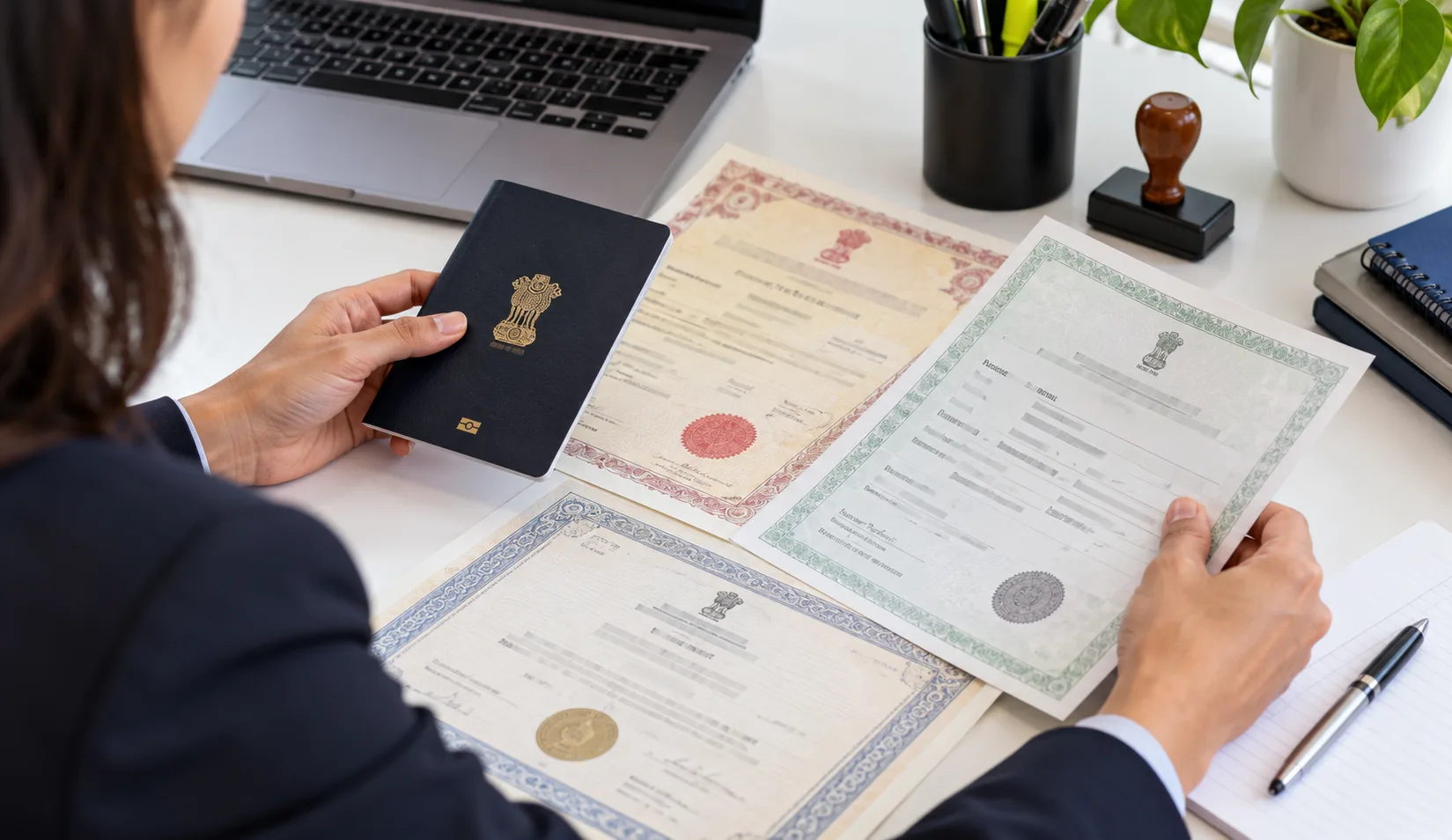
Many people from India, Pakistan and other countries run into the same problem in Germany: their name is written differently on different documents. A German office compares your passport, your birth certificate, your marriage certificate and your degree. If the names do not line up, the office may ask questions, return your file or ask for more proof.
This guide explains the most common situations, what a certified translator can and cannot do, and how to prepare your documents. For your translation, you can request a free quote.
Typical name problems
- Single names. Some people have only one name. German forms ask for a first name and a family name, and offices have to decide how to record it.
- Different order or format. A document may show “Sharma Rajesh Kumar”, another “Rajesh Kumar Sharma” and a third “R. K. Sharma”.
- Spelling variants. Muhammad, Mohammad, Mohammed or Kumar, Kumaar: small differences between documents are common.
- Initials. Many documents use initials for a father’s name or village, which have no equivalent on German forms.
- Name changes after marriage that are recorded in some documents and not in others.
- Different alphabets. A name written in Devanagari, Urdu or another script is transcribed into Latin letters, and different offices may have transcribed it differently.
What a certified translator does with names
A translator authorised in Germany translates what is in front of them, nothing more and nothing less.
- Names are transcribed exactly as written in each document, including the spelling.
- If you give us several documents that belong together, we can add a translator’s note where a name differs from another document, for example “name appears as … in the passport”. This helps the office understand that it is the same person.
- We do not correct or harmonise names. A translator cannot decide that one spelling is the right one. That would make the translation inaccurate.
What the passport usually means for your name in Germany
In most German offices, the passport is the reference for how your name is written. If you can, use the spelling from your passport on forms and in your correspondence. When you send us documents, tell us which spelling appears in your passport so that the notes in your translations point to the right one.
How an office records a single name or a variant spelling is decided by the office, not by the translator. If the office considers the difference significant, it may ask you for a declaration, for a correction at the issuing authority in your home country or for a supporting document. We cannot decide this for you, but we can guide you through it and translate any documents involved.
Before you order, do these five things
- Collect all the documents that belong to the same case, such as passport, birth certificate and marriage certificate.
- Check the names side by side. Mark every difference.
- Tell us the passport spelling and tell us what the office asked for.
- Send everything in one go, so we can keep the names consistent and add notes where needed.
- Ask the office if it needs anything else, for example a declaration or a correction from the issuing authority.
What to do if the difference is serious
If one document shows a clearly different name, for example a different surname, the cause may be a spelling mistake at the issuing office. In that case the safest path is often to ask the issuing authority for a corrected document and have the corrected one translated. Do not change documents yourself. Offices notice, and it can create much bigger problems.
If you are told you need an apostille or another form of legalisation on a corrected document, see our page on legalisations and apostilles.
Will the Bürgerbüro or registry office accept it?
A certified translation made by a translator authorised in Germany is what German offices usually expect. We cannot decide for the office or guarantee acceptance, because each office has its own checklist, and the office also decides how to record a name that differs between documents. Tell us the name of the office and what it asked for, and send its request if you have it in writing.
How ordering works with us
Send your documents by email, WhatsApp or our online form. We check them and tell you what is needed, then send a quote. See our prices page. You receive your certified translations by email, and by post if the office needs the stamped paper original. How long your case takes depends on the documents and the office, so write to us and we will tell you exactly in your case.
Frequently asked questions
My passport has only one name. Is that a problem in Germany?
Many people have single names. The office decides how to record it. Tell us how your passport shows it, and we will transcribe your other documents as written.
Can the translator change a name so it matches my passport?
No. A certified translation must reflect the original. We can add a note pointing out the difference.
My name is spelled differently on my birth certificate and my degree. What should I do?
Send both and tell us the passport spelling. We will transcribe each as written and add a translator’s note only when it can be justified. Ask the office if it needs more.
Will a translator’s note solve the problem?
It helps the office understand that the documents belong to the same person. The final decision stays with the office.
Will my Bürgerbüro or registry office accept your translation?
A certified translation by a translator authorised in Germany is what offices usually expect, but each office decides for itself. Tell us which office asked for it.
Can I get a PDF before the paper original?
Many offices want the paper original with stamp and signature. On request, we can also provide a PDF copy of the translation.
Do I pay in advance, and can I get an invoice?
Payment is made in advance after you accept the quote. You can receive the invoice online or by post, together with the translated documents, as you prefer.
Need your documents translated?
Send us your documents, tell us which office asked for them, and mention any name differences. We will reply with a clear quote and the next steps.
Request a free quote or contact us now, also on WhatsApp.
 Write us a review