
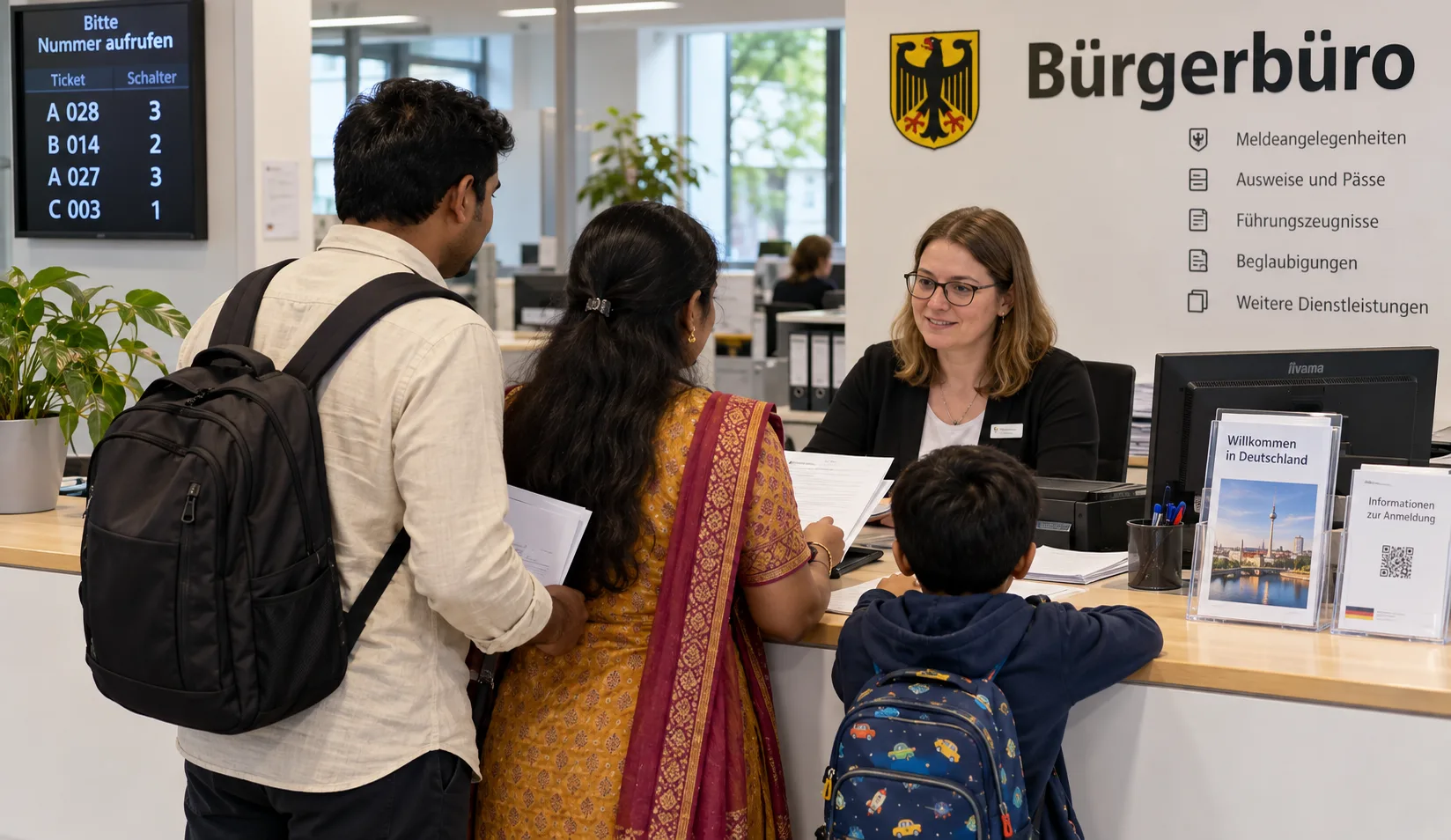
Moving to Germany with your family: which documents need a certified translation, and for which office
/ Useful informations
Short answer: the documents that most often need a certified German translation for a family are the children’s birth certificates and the marriage certificate. Which office asks for them, and in what form, varies from city to city. Some Bürgerbüros ask for them at Anmeldung, others do not, and the foreigners’ office (Ausländerbehörde) has its own rules. Ask each office before you order, and tell us which office it is.
Moving a family to Germany means a series of offices, each with its own list. People often translate everything at once and then find that one office needed a different document or a different form. This guide goes office by office, so you can order the right translations once. For your translations you can request a free quote.
The family documents that are usually translated
- Birth certificates of your children, and your own if requested. See our guide on birth certificate translation for Germany.
- Marriage certificate. See our guide on marriage certificates and Nikah Nama.
- Divorce decree, death certificate or proof of custody, if they apply to your family.
- Degrees and professional qualifications, if you plan to work. See degree certificates and transcripts and our guide on Anerkennung.
Passports and ID cards are shown in the original and are not usually translated. Ask the office if you are unsure.
Office by office
1. Bürgerbüro or residents’ registration office (Anmeldung)
You register your address within a short time after moving in. Everyone needs a valid ID and the landlord’s confirmation (Wohnungsgeberbestätigung). For families, some offices also ask for the marriage certificate and the children’s birth certificates. As an example, the University of Göttingen’s guidance for newcomers says that married couples and families with children bring a marriage certificate and the children’s birth certificates, with a certified German translation and, if needed, an apostille or legalisation. Other cities handle it differently. In our experience, some Bürgerbüros ask for translated certificates at Anmeldung and others do not.
What to do: check your city’s website or call the office, and ask exactly which certificates it wants and whether it needs a translation.
2. Foreigners’ office (Ausländerbehörde)
For residence permits, including family reunification, the foreigners’ office usually asks for the marriage certificate, the children’s birth certificates and sometimes proof of custody. Embassy notices for family reunification visas, which are issued abroad before you travel, generally say that documents in English do not need a translation, while documents in other languages need an official German translation, and marriage certificates often need an apostille or legalisation in addition. Once you are in Germany, the local office applies its own rules, so do not assume that what the embassy accepted is enough there.
What to do: ask the foreigners’ office for its checklist, and ask whether English documents are accepted as they are.
3. Registry office (Standesamt)
For marriage registration, a birth registration or a change of name, the Standesamt usually requires a translation by a translator publicly appointed or sworn in Germany. Some registry offices note that self-made translations are generally not accepted, and that a certificate not written in Latin script needs a transliteration according to the ISO standard. Some countries also issue international (multilingual) certificates, which a registry office may accept without a translation. Ask whether yours qualifies.
4. Schools, childcare providers, employers and insurers
These sometimes ask for a birth certificate or other documents. Rules vary, and a translation is not always needed. Ask in writing and tell us what they say.
Can I use the same translation at several offices?
Often yes, if each office accepts it, but not always. Some offices want a translation attached to a certified copy of the original. Some want a recent copy or a certain form. If you plan to use the same documents in several places, tell us when you order, with the offices’ requests if you have them in writing.
A simple order of steps
- Make a list of the offices you will visit and ask each one what it needs.
- Collect the originals of the family documents.
- Check the names across passports, certificates and school records. See names that do not match across documents.
- Ask whether an apostille or legalisation is needed. See legalisations and apostilles.
- Order the translations once, with all offices in mind.
- Keep copies of everything you submit.
How we can help
We translate the documents. We do not decide for you which ones an office needs. If a document is in English, we translate it into German. If it is in another language, write to us first and we will tell you whether we cover it.
- Send scans of the documents by email, WhatsApp or our online form, and tell us which offices will receive them.
- Receive a clear quote. See our prices page.
- Get your certified translations by email, and by post if an office wants the stamped paper original.
How long your case takes depends on the documents and on what the offices require, so write to us and we will tell you exactly in your case.
Frequently asked questions
Do I need translated certificates for Anmeldung?
It depends on the office. Some Bürgerbüros ask for translated marriage and birth certificates when you register your family, others do not. Ask your office before you order.
Is an English certificate accepted without a translation?
Sometimes. Embassy notices for visa procedures generally accept English documents without a translation. Offices in Germany often still ask for a German translation. Check with each office.
Can a family member or a friend translate my certificate?
Usually not. Offices generally expect a translation by a translator publicly appointed or sworn in Germany, and self-made translations are generally not accepted.
What is an international certificate?
Some countries issue multilingual certificates under international conventions. A registry office may accept them without a translation. Ask whether yours qualifies.
Will my office accept your translation?
A certified translation by a translator authorised in Germany is what offices usually expect, but each office decides for itself. Tell us which office asked for it and send us its request if you have it.
Can I get a PDF before the paper original?
Many offices want the paper original with stamp and signature. On request, we can also provide a PDF copy of the translation.
Do I pay in advance, and can I get an invoice?
Payment is made in advance after you accept the quote. You can receive the invoice online or by post, together with the translated documents, as you prefer.
Start your translation
Send us your family documents and tell us which offices asked for them. We will reply with a clear quote and the next steps.
Request a free quote or contact us now, also on WhatsApp.
 Write us a review